Equities Risk
Factor Mimicking Portfolio Analysis
An evaluation of commonly used equity characteristics and sensitivities to macroeconomic and statistical factors, for their ability to capture common return variation in the Australian equity market.
Methodology
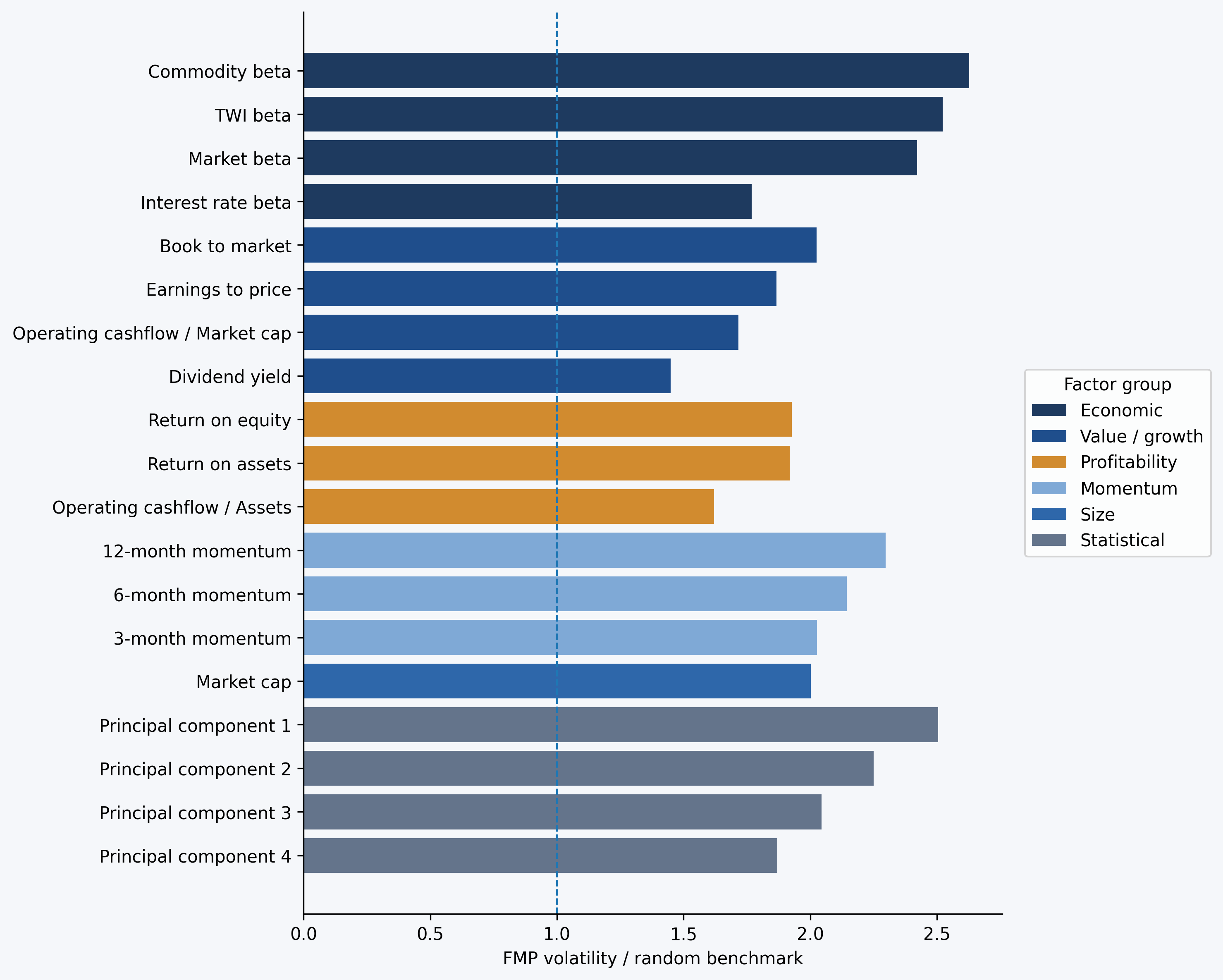
"Factor mimicking portfolios are constructed annually by sorting stocks in the All Ordinaries Index into terciles based on each characteristic or estimated factor exposure, using an approach adapted from Chan, Karceski and Lakonishok (1998), The Risk and Return from Factors, Journal of Financial and Quantitative Analysis, 33(2), 159–188. The volatility of the resulting high-minus-low portfolio return is compared with the similar high-minus-low volatility of randomly formed tercile portfolios. Values above 1.0 indicate greater return variation than would be expected by chance, indicating an ability to cature systematic return covariation.
Interpretation
We tested a number of factors categorised as either value/growth orientation, economic variables, profitability measures, momentum, size and statistical factors. Factors across these categories demonstrate varying abilities to capture systematic return covariation, motivating their consideration as potential candidates for inclusion in a multifactor risk model
Commodity beta is the time-series loading on the Bloomberg Commodity Index return; TWI beta is the time-series loading on the return of the trade-weighted index of currencies against the AUD; Market beta is the time-series loading on the All Ordinaries Accumulation Index return; Interest rate beta is the time-series loading on changes in yield spread between 10-year and 2-year government bonds. Principal components 1-4 are the loadings on the first four principal components estimated using the Asymptotic Principal Components method of Connor and Korajczyk (1988), Risk and Return in an Equilibrium APT: Application of a New Test Methodology Journal of Financial Economics, 21(2), 255–289.