Equities Risk
Statistical Factors and Observable Proxies
Correlation diagnostics for factor-mimicking portfolio returns, used to identify any overlap between statistical and the other factors.
Synopsis
Here we present the rank-correlations of the factor mimicking portfolio (FMP) returns for the shortlisted subset of observable factors, selected for their ability to capture systematic return variation. The purpose is to determine the extent to which apparently distinct factors are capturing similar return variation. High absolute correlations suggest overlapping exposures, while low correlations suggest more distinct sources of risk.
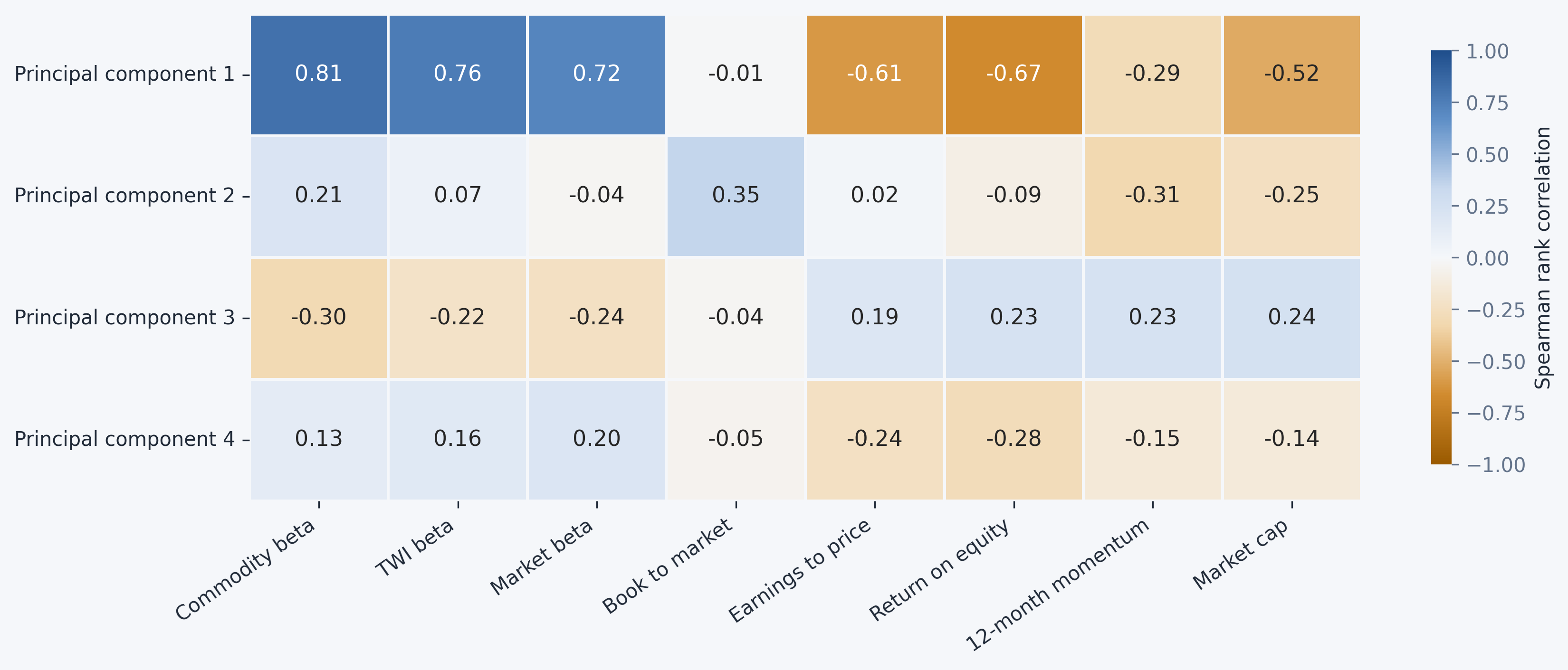
The first principal component is very strongly positively associated with commodity beta (0.81), TWI beta (0.76), and market beta (0.72), while being strongly negatively associated with ROE (-0.67), earnings-to-price (-0.61), and market capitalisation (-0.52). Book-to-market is essentially unrelated. Thus, the first principal component is more consistent with a latent macroeconomic or cyclical-risk dimension than with a conventional style factor. Firms with greater commodity, currency and market sensitivity are being contrasted with larger, more profitable and higher-earnings-yield firms.
Principal Component 2 exhibits a clear style-factor structure, with positive association with book-to-market and negative associations with market capitalisation and momentum. This provides independent support for the importance of the size and value dimensions in the Fama–French three-factor model, together with the momentum dimension introduced by Carhart’s four-factor model. Because principal-component signs are arbitrary, the interpretation rests on the pattern of relative exposures rather than their absolute signs.